
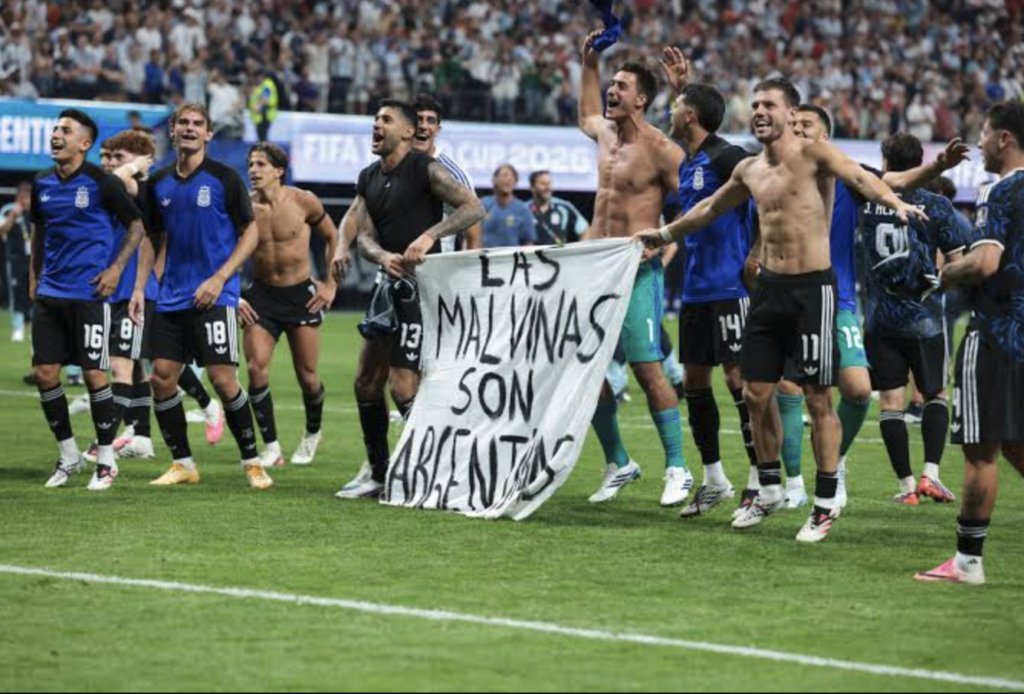
Argentina’s qualification for the 2026 World Cup final has been mired in a new controversy. After defeating England 2-1 in the semifinals, several Albiceleste players celebrated with a banner reading “The Falklands Are Argentine,” a gesture that prompted an immediate reaction from the UK government and could lead to an investigation by FIFA.
The incident occurred at the end of the match played in Atlanta, when Argentine fans handed the banner to the players during the celebrations. The images quickly went viral and reignited one of the most sensitive territorial disputes between the two countries.
United Kingdom demands an investigation
Hours after the celebration, the British government expressed its rejection of the message displayed by the Argentine players. A spokesperson for Prime Minister Keir Starmer reiterated the UK’s position on the Falkland Islands—as they are known in British territory—and asserted that self-determination rests with the archipelago’s inhabitants.
In addition, he confirmed that the British government supports the call for FIFA to review the incident and determine whether there was a violation of the organization’s disciplinary regulations.
This stance was reinforced by the UK Secretary of State for Business, Peter Kyle, who described the display of the banner as “totally inappropriate” within a global sporting event.
Can FIFA sanction Argentina?
FIFA’s Disciplinary Code stipulates that messages considered to be political, ideological, religious, or offensive are prohibited during official competitions.
If proceedings are initiated, both the players involved and the Argentine Football Association (AFA) could face financial penalties, as such violations are typically punished with fines ranging from $5,000 to $20,000, depending on the severity of the case.
So far, FIFA has not indicated whether it will formally launch an investigation into the incident.
Javier Milei backs the national team
From Argentina, President Javier Milei defended the players’ actions, arguing that the message reflects a sentiment shared by a large part of Argentine society.
However, he acknowledged that FIFA regulations could result in a financial penalty for the national team. As he explained, the players acted on the spur of the moment after securing a spot in the tournament final.
For her part, Vice President Victoria Villarruel also publicly expressed her support for the team and shared a photo of the players holding up the banner accompanied by the message: “The Falklands are Argentine!”, reaffirming the Argentine government’s historic position on the sovereignty of the archipelago.
FIFA’s Disciplinary Record
This would not be the first time FIFA has sanctioned political demonstrations related to territorial disputes.
In 2014, the Argentine national team itself displayed a banner with the same message during a friendly match before the World Cup in Brazil. On that occasion, FIFA imposed a fine on the Argentine football federation once the tournament had concluded.
Another similar case occurred after the 2012 London Olympics, when South Korean football player Park Jong-woo displayed a message regarding the dispute between South Korea and Japan over the Dokdo Islands. FIFA determined that the gesture was incompatible with the political neutrality required in international competitions and sanctioned the player.
More recently, during the 2022 World Cup in Qatar, the Serbian Football Association was fined for displaying a banner in its locker room related to the territorial dispute over Kosovo.
The historic rivalry between Argentina and England
The rivalry between Argentina and England extends beyond the realm of sports due to the conflict over the sovereignty of the Malvinas Islands, known in the United Kingdom as the Falkland Islands.
The dispute dates back to the 19th century and reached its most critical point in 1982, when the two countries were involved in a ten-week armed conflict that left 649 Argentine soldiers, 255 British military personnel, and three island civilians dead.
Since then, every football match between the two national teams has typically been imbued with strong symbolic and historical significance.
The World Cup final comes amid controversy
While FIFA considers whether to open a disciplinary investigation, Argentina is already preparing to face Spain in the 2026 World Cup final, a match to be held in East Rutherford, New Jersey.
The potential investigation adds a new twist to a World Cup that has already been marked by various disciplinary controversies. Now, all eyes will be on the decision made by international football’s governing body and on whether the Albiceleste’s celebration will have consequences beyond the field of play.